 back
back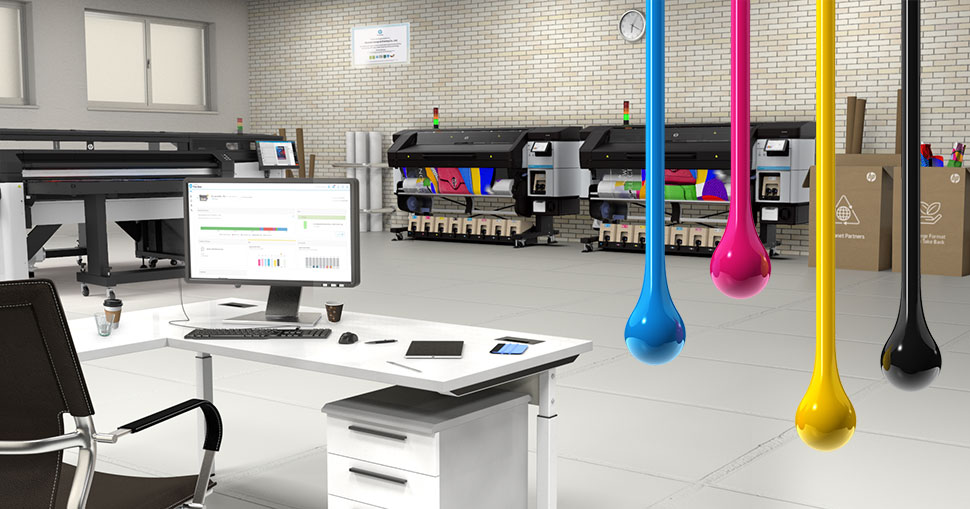
HP explains the sustainability of the latex ink printing technology
05.08.2021
Tom Brown, chief chemical engineer of inks at HP, answers several questions about HP Latex ink: “What is this?”, “How does it work?” and “What are the main advantages?”.
HP has been refining its Latex technology over the last decade to meet the demands of print service providers (PSPs), which according to many studies both among existing HP users and other customers who are not HP clients, boil down to fast and consistent production of easily marketable applications. This does not only mean high printer speeds with printing and no errors on standard media, it also means producing everything the end-user market wants. Environmental awareness and material diversity are increasingly demanded by print buyers – this is where HP Latex comes in. But what is it, how does it work, and what are the benefits for wide-format printing and signage companies?
The science of HP Latex
HP Latex is a water-based ink technology, which means up to 70% of the ink formula is water. The latest water-based HP Latex inks are developed to avoid harms associated with the impacts of other types of inks. The ink formula is combined with liquids and humectants necessary for the printhead reliability to produce a liquid ink solvent to carry the latex polymer and pigment particles to and through the printer’s printheads onto the media surface. The emitted heat and forced air flow evaporate the liquid and fix the latex, bonding the pigments and substrate together to leave a durable image on the media surface. The print is ready for use immediately, even for immediate lamination.
Contribution to ecology and health
HP is committed to a positive and lasting impact on preserving the planet by supporting people and helping the communities where we live, work, and conduct business. Take for example HP Latex’s water-based formula; this technology transformed the industry years ago and with every new generation continues to improve it.
HP Latex is formulated to have a sustainable impact and is further certified with multiple eco-labels and certificates; HP collaborates with associations throughout the industry to ensure it offers the best to its customers.
The latest HP Latex inks are UL ECOLOGO certified and meet strict health and environmental criteria, including toy safety requirements.
All HP Latex inks also hold GREENGUARD GOLD certification at unlimited level. This certification proves that a product has very low harmful emissions—even at full room coverage—and low enough to be used in sensitive environments like schools and hospitals. This benefits print service providers who want to sell into these markets as well as their employees: HP Latex printers have no special ventilation requirements, and HP Latex ink produces odorless prints. This is often a challenge for other ink technologies.
Thanks to the water-based formulation, the latest HP Latex inks make printed products an ideal, safe alternative to UV, UV gel, solvent, and eco-solvent inks.
All-in-one solution
Businesses that offer a wide range of products can potentially reach more customers—and more often and more profitably—if they manage to do this using the same equipment. Latex inks are suitable for direct printing on a long list of materials, with many media certified for use by manufacturers and suppliers worldwide. Print applications for signage include retail displays, outdoor signs, window graphics, vehicle branding, exhibition and event displays, wayfinding signs, stickers, apparel, and backlits.
Finally, HP has now expanded the variety and capabilities of its printers even further with the introduction of white HP Latex ink for use in its systems.
In the decoration market, Latex is also successfully used for fade-resistant blinds, canvases, wall coverings, PVC flooring, and textiles, including synthetic leather. This compatibility also allows print service providers to use alternative materials with certain ecological characteristics: reclaimed wood, papers certified by FSC, PVC-free materials, and textiles, for example.
Speed of execution
The HP Latex R2000 Plus, the largest of the new printers in the HP Latex series, can print at speeds up to 43 m²/h or 14 boards in “Production” mode and 86 m²/h or 28 boards in outdoor advertising mode (70%). However, execution time is not only about how fast this stage finishes; HP printer heaters warm up quickly and dry the applied ink immediately after printing through air recirculation to improve operational efficiency.
Cleaning is automated and daily maintenance is minimized, while HP-branded media and general media profiles are preloaded into the software to shorten the time operators spend on these processes. Complementary cutting systems are also developed to work with intuitive solutions.
While it is still debatable whether the most important part of HP’s technical solutions is the water-based ink, it is critically important that every part of the solution works to achieve results that provide flexibility and confidence to customers that it meets their environmental requirements.
Sustainability has been important to HP since the company’s inception and it is one of the most recognized sustainable companies worldwide. Therefore, as partners with HP, we share this common value and goal. The company’s latest goal continues to work toward zero carbon emissions, circular economy, ecosystem preservation through forest conservation, with the ambition to become the most sustainable and fair technology company.
For more details about the sustainability project of the latest HP Latex printers, see the link here.


Copyright © 2017 Mirage Group Ltd.